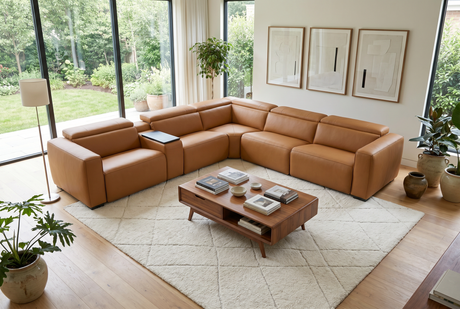
Sectional Sofa Buying Guide: The Complete 2026 Checklist
A sectional sofa is more than just a piece of furniture — it is the centerpiece of your living space, a hub for relaxation, and one of the most significant investments you will make for your home. Get it right, and your living room becomes the place everyone wants to be. Get it wrong, and you're stuck with a bulky, uncomfortable piece that doesn't fit your life.
This guide goes beyond the basics. We've combined expert advice, real buyer experiences, and a thorough look at what matters most — from sizing and quality to budget planning and long-term care — so you can buy with confidence.
1. Will the Sectional Fit in My Room and Through the Door?
This is the single most critical step — and the one most often skipped. Sectionals are large, and a common and expensive mistake is measuring only the floor space while completely ignoring the delivery path.
Measure the Space: Use painter's tape to outline the sectional's dimensions on your floor before you order. This gives you an accurate visual sense of how much space the sofa will take up and how much room is left for walking paths, other furniture, and breathing room. A general rule of thumb: leave at least 12–18 inches between the sectional and any adjacent wall or furniture piece. Not sure where to start? Our step-by-step guide on how to measure a room for furniture covers everything — from wall measurements and door swings to full delivery path clearances.
Measure the Path: Carefully measure every doorway, hallway, stairwell, and elevator your sofa will need to pass through on delivery day. Pay special attention to the diagonal measurement of the sofa's largest section — this is almost always longer than its width or depth alone. If any passageway is narrower than the sofa's diagonal, the delivery team may not be able to get it inside without disassembly.

Pro Tip: Take photos of your doorways and hallways with a tape measure visible and send them to the retailer. Most furniture companies can tell you immediately whether your specific sectional will fit.
2. How Will My Family and Guests Actually Use the Sofa?
Before you fall in love with a particular style or color, take a step back and think about how the sofa will actually be used day to day.
- Lounging vs. Entertaining: Sectionals are built for casual, relaxed comfort— perfect for stretching out for movie nights, curling up with a book, or lounging with family. They are less ideal for formal entertaining, where guests might feel awkward side by side rather than face to face. If your living room serves double duty, consider how you might arrange the rest of the room to support both scenarios.
- Modular vs. Fixed: If you move often, frequently rearrange your living space, or simply like the flexibility to adapt your furniture to different situations — a party, a holiday gathering, a movie marathon — a modular sectional is worth the investment. Modular sectionals are made of individual pieces that can be reconfigured, added to, or separated. Fixed L- or U-shaped sectionals, by contrast, offer a polished, cohesive look but are locked into one arrangement.
- Families with Kids: If children are part of the equation, think about seat depth, cushion durability, and how easy the fabric is to clean. Deeper seats mean kids (and adults) can fully settle in — but also mean smaller feet won't touch the floor. Look for sectionals with removable, washable cushion covers for easy maintenance.
3. What Configuration Is Best for My Room's Shape?
Not all sectionals are created equal. The shape you choose has a direct impact on how your room feels, how much space is left for other furniture, and how people naturally gather and interact.
- L-Shape: The most popular and versatile configuration. L-shaped sectionals fit neatly into corners, naturally define a seating area in open-concept spaces, and leave the most remaining floor space of any sectional shape. They work well in rooms of almost any size — just make sure the two arms of the L don't extend so far that they block doorways or windows.
- U-Shape: Ideal for larger rooms and for households that want to maximize seating. A U-shaped sectional creates an immersive, enclosed seating area that encourages conversation and togetherness. The trade-off is size — U-shapes can easily overwhelm a room under about 15 x 15 feet. They also make it harder to access the center of the room.
- Chaise Sectional: A great middle-ground option, especially for smaller rooms. The chaise adds a dedicated lounging spot — a built-in, angled seat where you can stretch out — without the bulk of a full L or U configuration. Chaise sectionals are also often more affordable than larger configurations.
-
Reversible Sectional: A smart choice if your room layout might change, or if you're not 100% sure which direction the chaise should face. Reversible Sectional Sofas allow you to flip the chaise from left to right, giving you flexibility without buying a new sofa.

4. How Can I Evaluate Quality Before I Buy?
A sectional is a long-term investment. The best-looking sofa in the showroom can become a sagging, wobbly disappointment within a year if the internal construction is poor. Here's exactly what to look — and feel — for:
Quality Checklist: What to Look For
| Component | What to Look For | Why It Matters |
|---|---|---|
| Frame | Kiln-dried hardwood (oak, maple, birch) | Prevents warping, cracking, and shifting over time. Engineered wood or particleboard frames are a red flag for long-term durability. |
| Construction | Sturdy, no wobble or flex when you push the frame | A well-built frame is the foundation of everything. If it feels loose in the showroom, it will only get worse with years of use. |
| Cushions | High-density foam (1.8 lb/cu ft or higher) | Lower-density foam flattens out quickly. High-density foam holds its shape for years. Look for reversible cushions — you can flip them to extend their life. |
| Padding | Fully padded back and sides, no hollow spots | Run your hand along the back and sides. Hollow or thin areas will become uncomfortable and wear out fast. |
| Connection System | Clip system, interlocking brackets, or bolts | This is what keeps the sectional pieces locked together. Without a strong connection system, the pieces will drift apart over time, especially with kids bouncing around. |
| Suspension | Eight-way hand-tied springs or sinuous springs | Springs support your weight evenly and prevent sagging. Eight-way hand-tied is the gold standard; sinuous springs are a reliable, more affordable option. |
| Reclining Mechanism (if applicable) | Smooth, quiet action with no grinding | If you're considering a reclining sectional, test the mechanism multiple times. A noisy or stiff mechanism will only get worse. |

A quick rule of thumb: If a sectional is significantly cheaper than comparable options and you can't figure out why, the quality shortcut is almost always in the frame or the cushion density.
5. What Fabric Should I Choose — and Why Does It Matter?
The upholstery is the most visible part of your sofa, and the wrong fabric choice can lead to years of frustration — from stains you can't remove to a sofa that looks worn after one season. Here's a practical breakdown:
Fabric vs. Leather: The Big Picture
- Fabric offers the widest range of colors, textures, and styles. It's softer and warmer to the touch, and generally more comfortable in extreme temperatures (it won't stick to your skin in summer or feel cold in winter, as leather can). The trade-off is that most fabrics are more vulnerable to stains and spills.
- Leather is exceptionally durable, easy to wipe clean, and develops a beautiful patina over time. It's a timeless choice that works in almost any decor style. However, genuine leather is expensive, requires conditioning to prevent cracking, and can be uncomfortable in very hot or very cold rooms.
Choosing the Right Fabric for Your Lifestyle
- For homes with pets: Choose a tight-weave fabric, such as microfiber, or a performance fabric designed to resist scratching and snagging. Avoid loosely woven fabrics like chenille or linen blends — cat claws and dog nails will pull the threads quickly. Velvet is surprisingly durable against scratches, but will show pet hair.
- For homes with young children: Stain-resistant or performance fabrics are your best friend. These fabrics are treated to repel liquids and resist staining without sacrificing comfort. Look for fabrics with a stain-resistance rating (ACT or similar) on the product description.
- For a formal or elegant look: Velvet adds instant luxury and visual depth. It's more durable than most people expect, but it does show wear in high-traffic areas over time. Pair it with a neutral color for a timeless look.
- For a casual, relaxed vibe: Linen blends or performance textiles in neutral tones are versatile, easy to style, and age gracefully. Avoid trendy colors — neutrals like charcoal, cream, and warm beige will look just as good in five years as they do today.
- For easy maintenance: Microfiber is the clear winner. It's soft, durable, stain-resistant, and one of the easiest fabrics to clean. It's also one of the most affordable options, making it an excellent choice for busy households.
6. How Much Should I Actually Budget for a Sectional?
This is the question most buying guides dance around. Here's an honest, straightforward breakdown of what different price points actually get you — and how to think about your budget smartly.
Price Ranges at a Glance
| Budget Range | What You Get | Best For |
|---|---|---|
| $1,000 – $1,500 | Synthetic or blended fabrics, engineered wood frame, basic cushioning. Functional and decent-looking, but unlikely to last more than 3–5 years with heavy use. | First apartments, temporary spaces, or a placeholder while you save for something better. |
| $1,500 – $3,000 | Better-quality fabrics or leather options, solid wood or reinforced frames, higher-density cushions, and more configuration options. This is the sweet spot for most buyers. | Permanent living rooms where comfort and durability matter. Most people end up happiest in this range. |
| $3,000 – $5,000 | Premium fabrics or genuine leather, kiln-dried hardwood frames, eight-way hand-tied springs, and advanced features such as power recliners or built-in chargers. These sofas are built to last 10+ years. | Buyers who want a long-term investment piece and are willing to pay for quality that lasts. |
| $5,000+ | Custom configurations, exotic materials, designer brands, fully handcrafted construction. | A showpiece sofa where aesthetics and craftsmanship are the priority. |
Hidden Costs to Budget For
The price tag on the sofa itself is rarely the full cost. Before you finalize your budget, factor in:
- Delivery: Most retailers charge $100–$250 for standard delivery. White-glove delivery (where the team carries the sofa into your home and sets it up) can cost $200–$500 or more, especially for large sectionals or multi-story homes.
- Assembly: Some sectionals arrive partially disassembled. If you'd rather not assemble it yourself, professional assembly can add $50–$150.
- Protection Plans: Many retailers offer fabric or leather protection plans for $100–$400. If you have kids or pets, this can be worth the peace of mind — but it's not always necessary if you choose a stain-resistant fabric from the start.
- Pillows & Throws: A great sectional deserves great accessories. Budget an extra $100–$300 for quality throw pillows and a cozy blanket to complete the look.
When to Spend More — and When to Spend Less
If you're furnishing a permanent home and plan to stay for years, investing in the $2,000–$3,000 range almost always saves money in the long run compared to buying a cheap sectional every 2–3 years. On the other hand, if you're in a temporary rental or a starter apartment, a budget-friendly option in the $1,000–$1,500 range is a perfectly smart choice.
Smart Tip: The best time to buy a sectional is during end-of-season sales (January/February and July/August), as well as on Black Friday, Labor Day, and Memorial Day. Retailers regularly discount 20–40% during these windows. If you have flexibility on timing, waiting for a sale can save you hundreds of dollars.
7. Will This Large Piece Overwhelm My Room?
A sectional is automatically the dominant piece in any room. That's not necessarily a bad thing — but it does mean you need to be intentional about how it sits in the space.
- Visual Weight: To keep the room from feeling heavy or cramped, choose a sectional with a slightly elevated base and slim, tapered legs. This allows light to pass beneath the sofa, creating a sense of openness and airiness—even in a smaller room.
- Placement: Pull the sectional 6–12 inches away from the wall. This small gap might seem counterintuitive — why not push it right up against the wall? — but it creates visual depth, makes the room feel more intentional, and also makes it easier to vacuum behind the sofa (which you should do regularly).
- Balance: Counterbalance the sofa's visual weight with something that draws the eye upward or to the side. A large piece of art above or near the sectional, a tall indoor plant, or an architectural feature like a fireplace or statement lighting fixture can all prevent the sofa from feeling like the only thing in the room.
- Color Strategy: If your sectional is bold or dark, keep the rest of the room lighter. If it's a neutral tone, you have more freedom to add color through pillows, art, and accessories. The goal is contrast and variety — not competition.
8. Is the Seat Depth and Height Right for My Body?
Comfort is deeply personal, and what feels amazing for five minutes in a showroom may feel terrible after five hours of actual use. Seat depth and height are the two most important dimensions to get right.
- Seat Depth: The measurement from the back of the seat to the front edge. Deeper seats (24 inches or more) are ideal for lounging—stretching out, tucking your legs under you, or curling up with a blanket. However, if you're on the shorter side, very deep seats can be uncomfortable because your feet won't reach the floor comfortably. Shallower seats (21–23 inches) are better for sitting upright, reading, or working.
- Seat Height: This is the distance from the floor to the top of the cushion. The ideal height allows you to sit with your feet flat on the floor and your knees at roughly a 90-degree angle. If the seat is too high, you'll feel perched; if it's too low, getting up becomes a workout.
A Practical Test: If you can, visit a showroom or furniture store and sit on sectionals in the range you're considering — for at least 10–15 minutes each. Sitting for a short time gives you a very different impression than actually relaxing on the sofa. Pay attention to how your back feels, where your feet land, and whether you feel supported or sinking.
9. What Is the Warranty and Return Policy — and Why It Matters More Than You Think
A sectional is a significant purchase. The fine print on warranties and returns is where many buyers get caught off guard — especially with online purchases.
Warranty: A quality sectional should come with a warranty of at least 5 years on the frame and springs. Cushion warranties are typically shorter — 1–3 years — because cushions wear faster. Before you buy, read the warranty terms carefully. Know what's covered, what's not, and what you need to do to file a claim. Some warranties require you to register the product within a specific window.
Return Policy: Confirm the exact return window (typically 14–30 days, though some retailers offer longer), any restocking fees (often 10–20% of the purchase price), and who pays for return shipping. For large sectionals, return shipping can easily cost $200–$500 if it's not covered. This is especially important for custom-ordered pieces, which many retailers will not accept returns on.
Pro Tip: The day your sectional arrives, take photos of it in its packaging and in its assembled state. Keep all original packaging materials for at least a week. If anything arrives damaged or doesn't match what you ordered, you'll want documentation immediately.
10. Should I Shop Online, In-Store, or Both?
The way people buy sectionals has changed dramatically in the last few years. Both online and in-store shopping have real advantages — and the smartest approach is often a combination of both.
The Case for In-Store:
- You can sit on the sofa and feel the actual fabric, cushion density, and frame quality.
- No guessing about color — screens are notoriously unreliable for furniture colors.
- You can get immediate advice from sales staff on configuration, sizing, and styling.
- No waiting for delivery — some stores offer same-day pickup or next-day delivery.
The Case for Online:
- A much wider selection of styles, colors, and configurations than any single store carries.
- Easier price comparison across multiple retailers.
- Often, lower prices are due to reduced overhead costs.
- Convenient for people who don't live near a large furniture showroom.
The Best Strategy: Start online to research styles, compare prices, and narrow down your favorites. Then, if possible, visit a store to test the feel in person — even if it's a different brand in a similar price range. Finally, make your purchase from whichever retailer offers the best combination of price, warranty, and return policy.
11. How Do I Keep My Sectional Looking New for Years?
Buying the right sectional is only half the battle. How you maintain it over time determines whether it looks great at year five or starts falling apart at year two. Here's a practical care routine that works for any upholstery type:
Weekly Care
- Vacuum regularly. Use your vacuum's upholstery attachment once a week — including between the cushions and underneath them. This is where dust, crumbs, pet hair, and allergens accumulate fastest. Skipping this step is the single fastest way to make a sectional look and smell old.
- Fluff and rotate cushions. If you notice one cushion looking more worn than the others, that's a sign it's getting more use. Rotate cushions every 1–2 weeks to distribute wear evenly. For cushions with loose filling (feather or fiber), give them a good shake or pat to redistribute the filling.
Monthly Care
- Wipe down the surface. For fabric sectionals, a quick pass with a slightly damp microfiber cloth removes surface dust and light grime. For leather or faux leather, wipe with a soft, damp cloth once or twice a month to keep it clean and supple.
- Treat spills immediately. The moment a spill happens, blot it with a clean cloth — never rub. Rubbing pushes the liquid deeper into the fabric and spreads the stain. For water-soluble spills (coffee, juice, water), blot with a damp cloth and a tiny amount of mild dish soap. For oil-based stains, use a fabric-specific stain remover and follow the product instructions.
Seasonal Care
- Deep clean every 3–6 months. Depending on how heavily the sectional is used, a deeper clean is warranted a few times a year. Steam cleaning is effective for most fabric types and removes dust mites and allergens. Always check the manufacturer's care label before steam cleaning — some fabrics are not steam-safe.
- Condition the leather. If your sectional is leather, apply a quality leather conditioner 2–3 times a year to keep it supple and prevent cracking or fading.
- Protect from sunlight. UV rays fade and dry out upholstery over time — both fabric and leather. If your sectional is near a window, use curtains or blinds during the brightest parts of the day, or consider UV-protective window film.
- When to Call a Professional
If a stain won't come out after your best efforts, or if the sectional has built up grime over time that routine cleaning hasn't addressed, a professional upholstery cleaning once a year is a smart investment. Professional cleaners have specialized equipment and solutions that go deeper than anything you can do at home — and it can genuinely make a years-old sectional look almost new again.
Smart Styling Tips to Tie the Room Together
A beautiful sectional deserves a beautiful room around it. Here are a few quick styling tips to make everything work together:
- Side Tables & Surfaces: The size of a sectional can push coffee tables out of easy reach for some seats. Plan to add a small side table or C-table near every 2–3 seats so everyone has a convenient surface for drinks, phones, and remotes.
- Coffee Table Sizing: If you have a coffee table in front of the sectional, it should be roughly two-thirds the length of the sofa's longest side, and positioned about 12–18 inches away from the seat. Too close and it feels cramped; too far and it feels disconnected.
- Layered Lighting: A sectional benefits from layered lighting — an overhead light for general illumination, a floor lamp for reading, and perhaps a warm-toned table lamp for ambiance. This creates depth and mood in the space, especially in the evening.
- Accent Colors: Use your throw pillows and blankets to pull in colors from elsewhere in the room — a color from your rug, your curtains, or a piece of art. This creates visual cohesion and makes the sectional feel like it belongs in the space rather than just sitting in it.
Frequently Asked Questions (FAQ)
What types of sectionals work best in small spaces?
For smaller rooms, a chaise sectional is one of the best options — it provides a lounging spot without the footprint of a full L- or U-shaped sectional. Reversible Sectional Sofas are another smart pick, as they let you change the chaise direction to fit different room layouts. A compact 2-piece or 3-piece sectional sofa can also work beautifully if the pieces are sized correctly for the room.
What's the difference between a sectional sofa and a sectional couch?
The terms are used interchangeably in the furniture industry — there is no meaningful difference. You can find a wide range of options by exploring both Sectional Couches and the main collection of sectional sofas. The choice comes down to style, size, and features — not terminology.
Can sectionals be used for sleeping?
Absolutely. There are several options designed with sleeping in mind:
- Sectional Sofa Beds: These feature a pull-out mattress hidden beneath the seat cushions. When you need a bed, you simply pull it out — and when you don't, it disappears completely.
- Sectional Sleeper Sofas: A broader category that includes pull-out beds as well as convertible sectionals, where the cushions fold down to create a flat sleeping surface.
How long does a sectional sofa last?
With proper care and quality construction, a well-made sectional can last anywhere from 7 to 15 years. The lifespan depends heavily on three factors: the quality of the frame and cushions, how often and how heavily the sofa is used, and how well it's maintained. Investing in higher-density foam cushions and a solid hardwood frame — and keeping up with regular cleaning and cushion rotation — will significantly extend the life of your sectional.
Should I buy a reclining sectional?
Reclining sectionals are an excellent choice if lounging and relaxation are a priority. Power recliners offer the smoothest, quietest action and are especially convenient for older adults or anyone with mobility considerations. The trade-offs are cost (reclining mechanisms add $300–$800+ to the price) and the need for an electrical outlet nearby for power recliners. If you're considering one, test the reclining mechanism thoroughly in the showroom — a stiff or noisy mechanism will only get worse over time.
When is the best time to buy a sectional?
The best times to find significant discounts on sectional sofas are during end-of-season sales in January/February and July/August, as well as major holiday sales like Black Friday, Labor Day, and Memorial Day. If your timeline is flexible, waiting for one of these windows can save you 20–40% off the regular price.