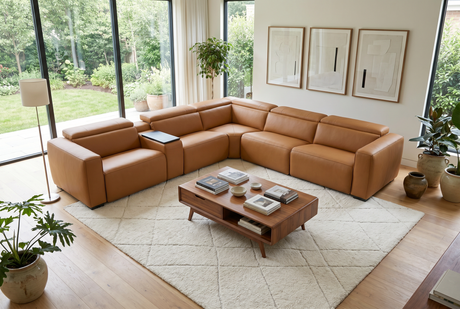
The Complete Guide to Outdoor Sectionals in 2026
An outdoor sectional is the one piece of patio furniture that defines how a whole space gets used, turning a deck, porch, or backyard corner into a room where a group actually wants to gather. The choice looks simple from a showroom photo, but it carries decisions that only reveal themselves after a season outdoors: how the pieces hold together, how the frame survives your specific weather, and how much space the set truly needs once people can move around it.
This guide walks through those decisions in the order a real buyer faces them. It compares the 4 main outdoor sectional configurations and who each one suits, explains the connector systems that decide whether a modular set stays aligned or slowly drifts apart, lays out a material approach matched to your climate rather than a generic durability chart, and covers the clearances that keep a layout comfortable instead of crowded.
The aim is to answer the questions most guides skip. Whether you are weighing a small outdoor sectional for a balcony, an L-shaped outdoor sectional for a deck, or a curved set built around a fire feature, each section gives you a direct answer first and the reasoning behind it second, so you can match the right sectional to your space with confidence.
What Are the Main Types of Outdoor Sectionals?
The main types of outdoor sectionals are 4 configurations: the L-shaped sectional, the U-shaped sectional, the curved sectional, and the fully modular sectional. Each layout matches a different space shape and seating goal, and the outdoor sofas and sectionals range carries examples of all four from brands such as Ashley Furniture, Furniture of America, and Classic Home.
In this infographic, we compare the four primary outdoor sectional configurations—L-shaped, U-shaped, curved, and modular—highlighting their seating capacities and ideal patio layouts to help you choose the best fit for your space.

L-Shaped Sectional
An L-shaped sectional joins two seating runs at a right angle to fit against a wall or into a patio corner. Most L-shaped sets seat 4 to 5 adults and span 8 to 10 feet (244 to 305 cm) along the longer arm. This is the most space-efficient layout for rectangular decks, balconies with a railing on two sides, and covered porches.
U-Shaped Sectional
A U-shaped sectional adds a third seating run, wrapping conversation around a central coffee table or fire feature. These sets seat 6 to 8 adults and need an open area of roughly 10 by 10 feet (305 by 305 cm). U-shaped layouts suit large patios and open lawns where the set anchors the space rather than hugging a wall.
Curved Sectional
A curved sectional replaces sharp corners with a continuous radius for a softer, more social seating arc. Curved sets seat 4 to 6 people and read best as a freestanding centerpiece because the back is fully exposed. The shape pairs naturally with a round fire pit or a circular outdoor rug.
Modular Sectional
A modular sectional ships as separate armless, corner, and end units that you arrange and rearrange as needed. The Ashley Furniture Bree Zee line shows the range clearly, sold in 2-piece, 3-piece, 4-piece, 5-piece, and 7-piece configurations that build from a loveseat up to a full wraparound. Modular sets give the most flexibility but depend most heavily on connectors to stay aligned.
|
Type |
Seats |
Footprint |
Best For |
|
L-Shaped |
4 to 5 |
8 to 10 ft long arm |
Corners, rectangular decks |
|
U-Shaped |
6 to 8 |
~10 by 10 ft |
Large patios, open lawns |
|
Curved |
4 to 6 |
Freestanding arc |
Centerpieces, fire features |
|
Modular |
2 to 8+ |
Reconfigurable |
Changing or shared spaces |
The configuration you choose sets the number of seams between modules, which directly affects how well the sectional stays together once people sit down.
Why Do Outdoor Sectional Pieces Come Apart, and How Do Connectors Stop It?
Outdoor sectional pieces come apart because most sets hold position by gravity and friction alone, and connectors stop it by mechanically locking adjacent modules together. Every time someone sits, shifts, or stands, lateral force pushes the modules apart at the seam, and a set without hardware slowly drifts into gaps. This is the most common complaint owners raise after a season of use, yet few buying guides explain it before purchase.
There are 5 connector systems used across outdoor sectionals, ranging from none at all to bolt-together hardware: gravity-only seating, hook brackets, alignment pins, spring clips, and through-bolts. The strength of the system, not the price tag, determines whether the set stays aligned.
|
Connector Type |
How It Works |
Hold Strength |
Notes |
|
Gravity only |
Modules rest side by side |
Weak |
Drifts with normal use |
|
Hook brackets |
Metal hooks slot together |
Moderate |
Easy to detach for storage |
|
Alignment pins |
Pins seat into matching holes |
Moderate |
Keeps faces flush |
|
Spring clips |
Sprung clip grips the frame |
Strong |
Tool-free, stays put |
|
Through-bolts |
Bolts fix frames rigidly |
Strongest |
Best for fixed layouts |
Before buying, check the product specification for the words bracket, clip, pin, or bolt. A set described only as stackable or interlocking by weight will move. To reduce drift on a set you already own, add aftermarket furniture clips, place a heavy outdoor rug under the full footprint for friction, or back the longest run against a wall. Connector quality and frame material work together, so the material a frame is built from decides both how the hardware anchors and how long the set survives outdoors.
What Materials Hold Up Best for an Outdoor Sectional in Your Climate?
The materials that hold up best for an outdoor sectional depend on your climate: marine-grade aluminum for coastal salt air, HDPE and resin wicker for high-UV regions, and sealed teak or eucalyptus for temperate zones. Matching material to climate prevents the two failures that cause most outdoor seating to retire early, which are corrosion and UV breakdown. Wood holds the leading material share across outdoor furniture at 28.7%, according to Future Market Insights, but the right choice shifts with where you live.
In this comprehensive infographic, we break down the best materials for outdoor sectionals based on specific climates, comparing powder-coated aluminum, HDPE poly lumber, teak wood, and synthetic resin wicker on key performance factors and lifespan to help you find the most durable option for your environment

In this table, we provide a direct comparison of the most popular outdoor sectional materials, evaluating their weather resistance, weight, maintenance requirements, and expected lifespan to help you match the right frame to your local climate conditions.
|
Material |
Weather Resistance |
Weight |
Maintenance |
Lifespan |
|
Powder-coated aluminum |
Excellent, corrosion-free |
Light |
Low |
20+ years |
|
Synthetic resin wicker |
Very good, UV-treated |
Light |
Low (rinse) |
10 to 15 years |
|
Teak |
Excellent, natural oils |
Heavy |
Low (optional sealing) |
20+ years |
|
HDPE poly lumber |
Excellent, UV and moisture |
Heavy |
None (wash only) |
20+ years |
|
Steel (powder-coated) |
Good if coating intact |
Heavy |
Moderate (inspect) |
10 to 15 years |
Frame strength also sets a sectional's weight limit. POLYWOOD tests its seating to ASTM International standards and rates single seats at 300 pounds (136 kg) and two-person seats at 600 pounds (272 kg), according to the manufacturer, which is a useful benchmark when comparing how much load each module carries.
Use this climate framework to narrow the list before comparing styles:
• Coastal and salt air: choose marine-grade aluminum with stainless hardware, since salt pits steel and untreated metals within a season.
• High-UV desert and Southern sun: choose HDPE poly lumber or UV-stabilized resin wicker, which resist fading and surface cracking.
• Freeze-thaw and snow regions: choose aluminum or HDPE frames, and store cushions indoors so trapped water cannot freeze and split seams.
• Humid and shaded yards: choose teak or eucalyptus with mold-resistant cushion covers, because constant moisture invites mildew on fabric first.
Frame material is only half the system. Cushion fabric carries the rest of the durability load, and solution-dyed acrylic, such as Sunbrella resists UV fading and mold growth far longer than printed polyester, according to the manufacturer's published performance data. Once the material and fabric are set, the remaining decision is fitting the sectional to the actual dimensions of your space.
How Do You Choose the Right Size and Layout for an Outdoor Sectional?
You choose the right size by measuring your usable area, then matching it to the sectional's overall length, depth, and the clearance a walkway needs. Leave at least 18 inches (46 cm) between the seat front and a coffee table, and keep a 3-foot (91 cm) walking path around the open sides. When the layout centers on fire pits or a coffee table, measure from that focal point outward so seats face the center evenly.
|
Set Size |
Typical Seats |
Overall Length |
Minimum Open Area |
|
2-piece (loveseat + corner) |
2 to 3 |
5 to 6 ft (152 to 183 cm) |
7 by 7 ft (213 by 213 cm) |
|
3-piece L-shape |
4 |
7 to 8 ft (213 to 244 cm) |
9 by 9 ft (274 by 274 cm) |
|
5-piece L-shape |
5 to 6 |
9 to 11 ft (274 to 335 cm) |
11 by 11 ft (335 by 335 cm) |
|
7-piece U-shape |
6 to 8 |
10 to 13 ft (305 to 396 cm) |
12 by 12 ft (366 by 366 cm) |
Seat depth matters as much as length. A deep-seat sectional measures 34 to 40 inches (86 to 102 cm) front to back and suits lounging, while a standard 30 to 33-inch (76 to 84 cm) depth keeps an upright posture for conversation. Confirm the door, gate, or stairwell that the set must pass through, because a one-piece curved sectional cannot be angled the way separate modular units can. Sizing leads naturally to a broader question of whether a sectional is even the right format for your patio compared with the alternatives.
How Does an Outdoor Sectional Compare to Other Patio Seating?
An outdoor sectional compares to other patio seating by trading flexible arrangement for a larger fixed footprint and more total seats. Against separate pieces, a sectional wins on cohesion and seat count, while a sofa-and-chairs setup wins on rearrangement and traffic flow. A one-piece outdoor couch offers the simplest option when you only need to seat 2 to 3 people and value easy moving over capacity.
|
Format |
Seats |
Flexibility |
Best Use |
|
Sectional |
4 to 8 |
Low to moderate |
Dedicated lounge zone |
|
Sofa + chairs |
4 to 6 |
High |
Spaces you rearrange often |
|
Conversation set |
4 |
Moderate |
Smaller balconies and porches |
A sectional is the wrong choice in 3 situations: a narrow balcony under 7 feet (213 cm) wide, a space you redesign every season, or a household that moves frequently and would rather not handle bulky corner units. For everyone else who wants a stable outdoor living room, a sectional delivers the most seating per square foot. The practical care details below decide how well that investment lasts.
How Do You Keep Outdoor Sectional Cushions From Getting Waterlogged?
You keep outdoor sectional cushions from getting waterlogged by choosing quick-dry reticulated foam, pairing it with solution-dyed acrylic covers, and storing cushions during long wet spells. Reticulated foam has open cells that let water pass straight through and drain in hours, while standard closed-cell foam holds water for days and breeds mildew. The same cushion logic applies across patio seating, including lounge chairs, where trapped moisture is the leading cause of early replacement.
• Specify quick-dry or reticulated foam for any cushion left outdoors year-round.
• Choose covers with hidden mesh drainage panels or grommets on the underside.
• Stand cushions on edge after heavy rain so both faces dry evenly.
Can You Leave an Outdoor Sectional Outside Year-Round?
You can leave an outdoor sectional outside year-round if the frame is corrosion-resistant and you protect the cushions from prolonged moisture. Aluminum, HDPE, and UV-stabilized resin wicker frames handle all 4 seasons without degradation. In freezing climates, remove cushions to a deck box or indoors so absorbed water cannot freeze, expand, and split seams overnight.
How Do You Protect an Outdoor Sectional From Sun Fading?
You protect an outdoor sectional from sun fading by combining UV-resistant materials with overhead shade during peak hours. Direct midday sun is the single largest cause of color loss on cushions and resin weave. A patio umbrella or a pergola cuts UV exposure across the seating zone and can extend cushion color life by years.
Should You Buy a Modular or a Fixed Outdoor Sectional?
You should buy a modular sectional if you rearrange your space often or move frequently, and a fixed sectional if you want a stable, set-and-forget layout. Modular units like the Ashley Furniture Bree Zee series separate into single seats for cleaning, storage, or new arrangements. Fixed or bolt-together sets, including teak builds such as the Classic Home Livia, hold one shape permanently and resist drift better because the frames lock rigidly.
Frequently Asked Questions About Outdoor Sectionals
Do Outdoor Sectional Couches Come Apart While You Sit on Them?
Gravity-only sectionals do drift apart with normal use, while sets with clips, brackets, or bolts stay locked together. The fix is hardware, not weight. Sets that list spring clips or through-bolts in the specification keep their seams flush, even with daily use by 4 to 6 people.
How Big Is a Standard Outdoor L-Sectional?
A standard outdoor L-sectional spans 8 to 10 feet (244 to 305 cm) along the long arm and seats 4 to 5 adults. The short arm typically runs 5 to 6 feet (152 to 183 cm). Allow an open area of at least 9 by 9 feet (274 by 274 cm) so a walkway stays clear on the open sides.
What Is the Most Durable Material for an Outdoor Sectional?
The most durable materials are powder-coated aluminum for frames and HDPE poly lumber for solid construction, both rated for 20+ years outdoors. Aluminum will not corrode, and HDPE resists UV, moisture, and cracking without sealing. Teak matches that lifespan among natural woods because its oils repel rot and insects.
How Do You Clean an Outdoor Sectional?
You clean an outdoor sectional with mild soap, warm water, and a soft brush, rinsing every 1 to 2 months during the use season. Remove cushion covers and air-dry them fully before refitting. Wipe aluminum and HDPE frames directly, and treat resin wicker gently to avoid fraying the weave.
How Do You Complete an Outdoor Sectional Setup?
You complete an outdoor sectional setup by adding a coffee or fire table, an anchoring rug, and a nearby dining area for full outdoor living. Many buyers pair the lounge zone with a separate outdoor dining set so the patio handles both relaxing and eating. A 9-foot (274 cm) shade element over the seating ties the zones together.
Ornate Home carries authorized outdoor sectionals from brands built to the durability and comfort standards in this guide, including Ashley Furniture, Furniture of America, Classic Home, and ACME, in aluminum, resin wicker, and teak. As an authorized dealer, Ornate Home provides manufacturer-backed warranties and the Ornate Care Standard, which includes delivery options such as White Glove, In-Room, and Threshold or Curbside service depending on the product.
Sources
• Future Market Insights, Outdoor Furniture Market Global Analysis Report, March 2026.
• ASTM International, Standard Consumer Safety Specification for outdoor furniture seating, 2025.
• POLYWOOD, Product Weight Capacity and ASTM Testing Specifications, manufacturer documentation, 2026.
• Sunbrella, Solution-Dyed Acrylic Performance and Fade Resistance Data, manufacturer documentation, 2026.