What Are the Best Fabrics for Pet-Friendly Couches?
The best fabrics for pet-friendly couches are microfiber, tightly woven performance synthetics, top-grain leather, and dense flat weaves such as canvas and denim, with short-pile performance velvet as a strong conditional pick. That short list hides the more useful truth: there is no single best pet friendly couch material, because cats and dogs damage upholstery in completely different ways. Cats punish loose weaves by snagging them. Dogs punish surfaces that trap hair, moisture, and odor. The right fabric answers the specific failure your household actually produces.
This guide treats fabric selection as a matching problem rather than a ranking. It separates the 4 ways pets damage a couch, compares the 5 fabric families that survive them, and explains how your pet type should change the decision. It also covers the part most buying guides skip: how to read a fabric spec sheet, why a 15,000 double rub abrasion rating matters less against claws than weave density, and which cleaning codes signal a surface you can maintain at home. Construction choices count as much as the textile itself, from cushion fill and removable covers on sectional sofas to the puncture resistance that separates fabric from leather sectionals.
Read the sections in order if you are starting from zero, or jump straight to the pet-type section if you already know your main problem is claws, hair, or accidents. The goal is the same either way: a couch you stop protecting and start living on.
What Makes a Couch Fabric Pet Friendly?
A couch fabric is pet friendly when its weave resists claw snags, its surface releases hair instead of gripping it, its structure blocks moisture from reaching the cushion core, and its finish tolerates frequent cleaning. Pets damage upholstery through 4 distinct mechanisms: claw snags that pull yarn loops out of the weave, surface abrasion from circling and nesting, moisture and odor from accidents, drool, and wet coats, and embedded hair and dander that work into the fiber. No fabric wins all 4 categories at once, so the smartest approach is to identify the 2 mechanisms your household actually faces and choose against those.
Surface abrasion is the mechanism buyers overrate. Upholstery failures in real use come far more often from inappropriate cleaning and poor maintenance than from surface wear, according to member research by the Association for Contract Textiles. A fabric you can clean easily and correctly outlasts a technically tougher fabric you cannot. The comparison below scores each major pet friendly couch fabric family against the damage mechanisms that matter.
Which Fabrics Work Best for Couches in Homes with Pets?
The fabrics that work best for couches in homes with pets are microfiber, performance synthetics, top-grain leather, and tight flat weaves such as canvas and denim, followed by short-pile performance velvet as a conditional option. Each family dominates a different damage category, and all of them upholster formats from compact loveseats to full sectional sofas, so the fabric decision and the format decision should happen together. There are 5 fabric families worth comparing: microfiber, performance weaves, leather, canvas and denim, and short-pile velvet.
| Fabric | Claw Snags | Hair Release | Moisture and Odor | Weak Point |
|---|---|---|---|---|
| Microfiber | Excellent | Very good | Good | Static can hold fine undercoat hair |
| Performance weave | Very good | Very good | Excellent | Quality varies widely by brand |
| Top-grain leather | Poor against punctures | Excellent | Excellent | Scratches stay visible |
| Canvas and denim | Very good | Good | Moderate | Untreated fibers absorb stains |
| Short-pile velvet | Good | Good | Moderate | Only performance versions qualify |
How Does Microfiber Hold Up Against Pet Damage?
Microfiber holds up against pet damage better than any other fabric at its price level because its polyester strands measure finer than 1 denier and pack into a weave too dense for most claws to hook. The tight surface also releases hair under a standard vacuum pass, and most microfiber and microsuede couches carry a W or WS cleaning code, which means water-based cleaners handle common pet messes. The weak points of microfiber are static cling, which can hold very fine undercoat hair, and oil-based stains that bond with polyester. Microfiber suits cat households best of all the options here, and performance weaves compete with it most closely on every other count.
What Are Performance Fabrics and Do They Earn the Label?
Performance fabrics are synthetic or treated upholstery weaves engineered to resist stains, moisture, abrasion, and fading, and they earn the label when the protection is built into the fiber rather than sprayed on afterward. Solution-dyed fibers carry pigment through the entire strand, so the color survives both scrubbing and sunlight, which matters in bright rooms where daily sun exposure fades conventional fabric along one arm. Several pet-rated weaves also add a physical barrier layer between the surface pile and the backing loops, giving claws nothing structural to pull. Spray-applied treatments thin with every deep cleaning, so ask whether the resistance is inherent to the fiber or applied to it before paying the premium, and apply the same scrutiny to leather grades.
When Is Leather the Right Choice for a Pet Household?
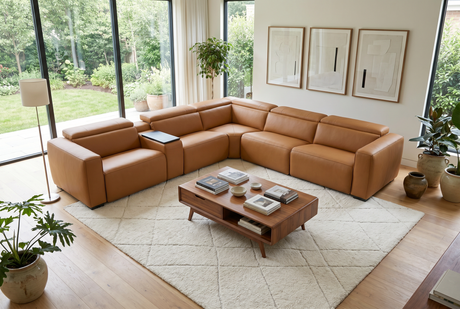
Leather is the right choice for a pet household when shedding, odor, and accidents are bigger daily problems than scratching. Hair cannot embed in a smooth hide, dander wipes away instead of accumulating, and spills sit on the surface long enough to clean before they soak in. Modular leather sectionals extend that advantage with replaceable pieces: the Ashley Furniture Emilia modular series, for example, sells its 49-inch (124 cm) wide corner chairs as individual units, so a damaged section can be swapped without replacing the whole configuration. Read upholstery descriptions closely, because leather match construction uses genuine leather only on the seating surfaces with matching polyurethane on the sides and back, and polyurethane punctures more easily under claws. Cat households should treat leather with caution regardless of grade, since claws puncture hide rather than snag it, and some cats actively target smooth leather surfaces.
Why Do Canvas and Denim Weaves Suit Homes with Claw-Heavy Pets?
Canvas and denim weaves suit homes with claw-heavy pets because both are flat, tight constructions with no raised loops or pile for a claw to catch. Heavy cotton duck and denim also tolerate aggressive scrubbing, and slipcovered versions go straight into a washing machine, which makes them one of the few genuinely washable pet friendly couch options. The trade-off is absorption: untreated natural fibers drink the liquids that synthetics repel, so canvas performs best either treated or in households where accidents are rare. Weave logic like this is exactly why the type of pet you own should drive the decision more than any general ranking.
How Should Your Pet Change Which Couch Fabric You Buy?
Your pet should change which couch fabric you buy because cats and dogs attack upholstery through different mechanisms that reward opposite fabric properties. A ranking that ignores the animal produces the wrong purchase in both directions: cat owners end up with punctured leather, and dog owners end up with hair-covered weaves that were never at snag risk in the first place. The 3 household profiles below cover the realistic cases.
What Should Cat Owners Prioritize in a Couch Fabric?
Cat owners should prioritize weave density above every other specification, because a cat's damage mechanism is the snag: a claw hooks a yarn loop and pulls it out of the weave. That single fact disqualifies several popular textures, including boucle, chenille, tweed, herringbone, and basket weaves, all of which present raised loops or ribs a claw can catch. Microfiber, microsuede, dense canvas, and short-pile performance velvet give claws no purchase, so an idle scratch slides off instead of pulling a thread. A smooth surface also makes the couch less rewarding as a scratching target than a sisal post placed directly beside it.
What Should Dog Owners Prioritize in a Couch Fabric?
Dog owners should prioritize hair release and moisture handling, because a dog's damage mechanism is rarely the claw snag and almost always the combination of shedding, drool, wet coats, and the occasional accident. A W or WS cleaning code, a smooth surface that surrenders hair to a vacuum, and quick-drying synthetic fiber cover the realistic failure modes. Households in humid regions gain extra value from fast-drying weaves, since moisture that lingers inside a cushion produces the wet-dog odor no surface cleaner removes, and removable machine-washable cushion covers turn a weekend disaster into a laundry cycle. Large breeds add a structural demand: seat cushions with high-resilience foam at 1.8 lb per cubic foot (29 kg per cubic meter) or denser recover from a 70-pound (32 kg) dog's favorite spot, while soft blended fills flatten and show every landing.
What Works for Homes with Both Kids and Pets?
Homes with both kids and pets get the best results from performance fabric in a mid-tone color, machine-washable covers, and a modular format that lets you replace 1 damaged piece instead of the entire couch. Mid-tones hide more than either extreme, since white broadcasts dirt and black broadcasts hair and lint. Patterned or heathered weaves disguise the small marks that accumulate faster in kid and pet friendly couches than in any other household. All of these judgment calls appear on a fabric spec sheet once you know which lines to read.
What Should You Check on a Fabric Spec Sheet Before Buying?
You should check 4 lines on a fabric spec sheet before buying a pet-friendly couch: the abrasion rating, the cleaning code, the pile description, and the fiber or treatment type. Together, they predict real-world survival better than any showroom impression.
- Abrasion rating. The Association for Contract Textiles sets 15,000 double rubs on the Wyzenbeek test as its guideline for residential upholstery and 30,000 for high-traffic use. Treat 15,000 as the floor for a pet household, but do not chase huge numbers: ACT states that results above its high-traffic guideline have not been shown to predict longer fabric life, and abrasion tests measure flat rubbing rather than the snags and punctures pets actually inflict.
- Cleaning code. W means water-based cleaners are safe, S requires solvent cleaners, WS accepts both, and X permits vacuuming only. Pet households should hold out for W or WS, because an S or X code turns every accident into a professional cleaning appointment.
- Pile description. Flat weaves and short, dense pile release hair and resist snags. Loop constructions and long pile fail on both counts, whatever the fiber content.
- Fiber and treatment type. Solution-dyed synthetic fiber keeps its color through cleaning and sunlight, while spray-applied treatments thin with every deep clean.
The spec sheet describes the textile, but several construction details outside the fabric decide how the couch survives day to day.
Which Construction Details Matter Beyond the Fabric?
The construction details that matter beyond the fabric are cushion fill, back style, cover design, leg height, and color strategy, and together these 5 factors influence lifespan as much as the upholstery itself.
- Cushion fill. High-resilience foam recovers its shape after every nap. The Ashley Furniture Elyza modular sectional pairs durable polyester upholstery with feather-fiber cushions, a combination that suits pet owners willing to fluff cushions daily; the same fabric over dense foam suits those who are not.
- Back style. Tight-back couches present fewer crevices, while loose pillow backs collect hair in every seam.
- Cover design. Zippered, removable cushion covers can be laundered or replaced, while attached cushions can only be spot cleaned in place.
- Leg height. Exposed legs with about 7 inches (18 cm) of clearance let a vacuum or robot vacuum reach the hair that migrates under every couch, while skirted bases trap it.
- Color strategy. Shed hair stays far less visible between vacuum passes if the upholstery tone matches your pet's coat, and mid-tone colors forgive the most in mixed households.
A couch chosen this carefully still depends on how you maintain it once the pets move in.
How Do You Keep a Pet Friendly Couch Looking New?
You keep a pet friendly couch looking new by pairing a weekly cleaning routine with habits that prevent damage before it starts. Vacuum the upholstery 1 to 2 times per week with a brush attachment to lift hair before it works into the fiber. Treat accidents with an enzyme cleaner, which breaks down odor-causing proteins instead of masking them, and dry cleaned spots quickly in humid climates so moisture never settles into the cushion core. Trim snagged threads immediately rather than pulling them, place a scratching post directly beside the corner your cat targets, and keep a washable throw on the single cushion your pet has claimed. Rotate cushions monthly in sun-heavy rooms so fading spreads evenly instead of bleaching one arm. The questions below cover the specific fabrics and formats pet owners ask about most.
Are Velvet Couches Pet Friendly?
Velvet couches are pet-friendly only when the pile is short, dense, and synthetic. Performance velvet has no loops or loose threads for a claw to catch, so cats find nothing to snag, and its smooth nap releases hair more readily than textured weaves. Traditional long-pile or silk-blend velvet behaves oppositely: it crushes, marks, and grips hair, which is why velvet appears on both best and worst lists depending on which version the writer tested.
Is a Corduroy Couch Pet Friendly?
A corduroy couch is pet-friendly for most dog households but risky for cats. The raised wales resist abrasion well and hide light wear, which suits dogs, and reclining sectionals with corduroy-textured cushions, such as the Signature Design by Ashley Top Tier series at 133 inches (338 cm) wide, hold up well under heavy family use. Cats change the math because the rib channels give claws a repeating edge to catch, and hair settles into the grooves between wales where a quick vacuum pass misses it.
Are Reclining Couches Safe for Pets?
Reclining couches are safe for pets when you close the mechanism after every use and check beneath the footrest before operating it. Small pets can slip under an open footrest or inside the frame, and a power model can move because a paw pressed a button, so switch power recliners off whenever you leave the room. Mechanism and frame quality also vary widely across manufacturers, and this guide to the best reclining sofa brands compares reclining frames, mechanisms, and upholstery durability across every major price tier.
Should You Use a Couch Cover with Pets?
You should use a couch cover with pets when you want to protect an existing couch, but a washable throw over the landing zone beats a full slipcover for daily life. Full covers shift, bunch, and hide the couch you chose, while a fitted throw protects the 1 or 2 cushions a pet actually uses and goes into the washing machine weekly. Households replacing a couch outright do better selecting a snag-resistant fabric from the start than dressing a vulnerable one.
Which Sectional Configuration Works Best for a Pet Household?
The sectional configuration that works best for a pet household is a modular design with individually replaceable pieces, since damage rarely spreads evenly across a couch. A chaise gives a dog a dedicated stretch-out zone that spares the main seats, and armless units can be swapped or rearranged when 1 section wears ahead of the rest. Measuring, configuration, and delivery-path planning follow the same rules for pet households as for any other, and this sectional sofa buying guide walks through each step, including the 12 to 18 inch (30 to 46 cm) clearance rule around the couch footprint.
At Ornate Home, we stock pet-friendly couches and sectionals from Ashley Furniture, Signature Design by Ashley, Coaster, and ACME in microfiber, performance fabric, and genuine leather, and as an authorized dealer we back every piece with its factory warranty. You can test fabrics in person against the checklist above at our showrooms in Santa Ana, California and Charlotte, North Carolina, and every order ships with Threshold, In-Room, or White Glove delivery options under the Ornate Care Standard. Bring your fabric questions, and bring a photo of the pet the couch has to survive.
Sources
- Association for Contract Textiles, Voluntary Performance Guidelines: Abrasion, Woven Fabrics for Indoor Use, contracttextiles.org, https://contracttextiles.org/performance-guidelines/abrasion-low-traffic-woven-fabrics/
- Association for Contract Textiles, Abrasion Disclaimer, contracttextiles.org, https://contracttextiles.org/performance-guidelines/abrasion-disclaimer/